AI Summarizer
Condense long articles and documents into concise summaries
Why Summarization Is a Critical Skill in the Information Age
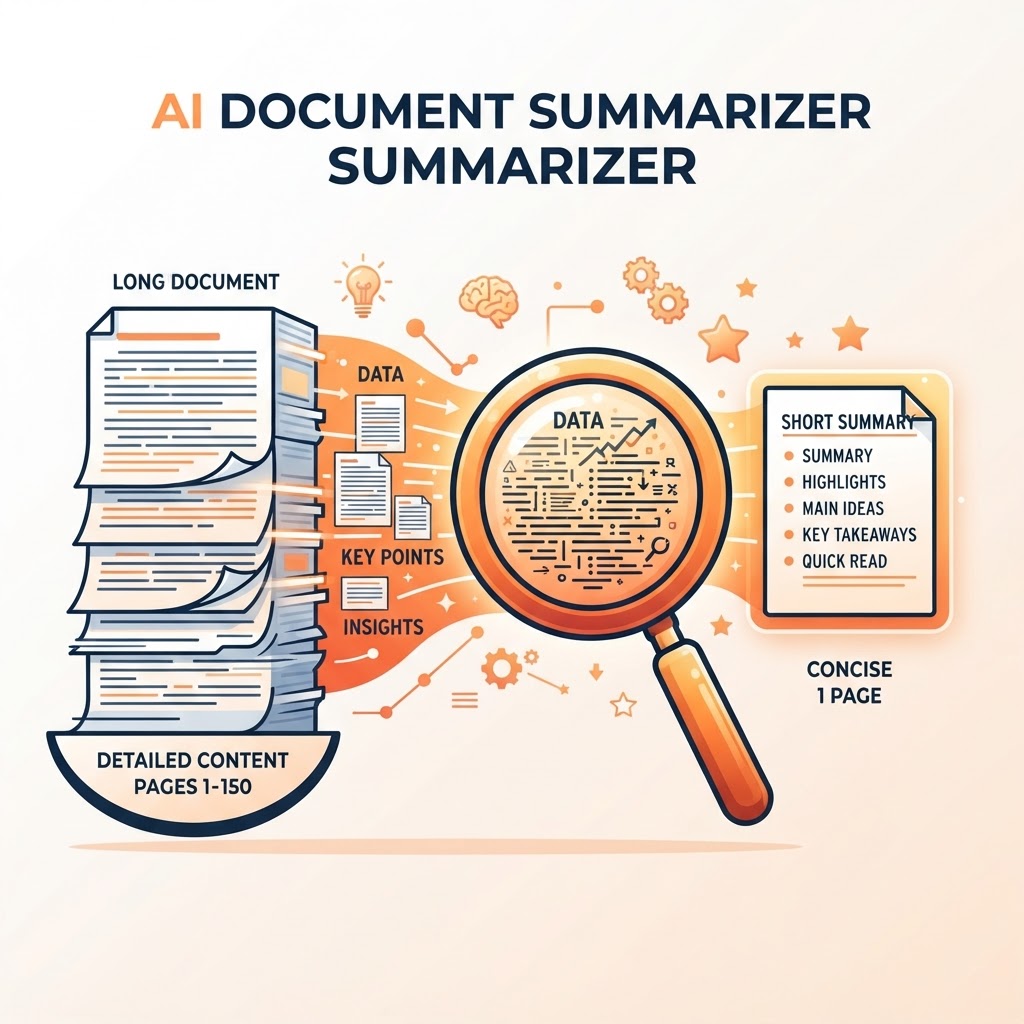
The modern professional reads more in a day than a 19th-century scholar read in a month. Reports, articles, emails, research papers, and meeting notes pile up faster than anyone can process. The ability to quickly extract the key points from a long document is no longer a luxury — it is a survival skill. An AI summarizer automates this, condensing thousands of words into a concise summary that captures the essential information in seconds.
Summarization serves two purposes. First, it helps you decide whether a document is worth reading in full — a summary tells you if the content is relevant before you invest the time. Second, it helps you retain information — a concise summary is easier to remember and reference than a sprawling original. Both purposes make a summarizer one of the most practical tools in a knowledge worker's toolkit.
How AI Summarization Works
Our AI summarizer uses advanced language models that understand the meaning of a document, not just its keywords. When you submit text, the model identifies the most important sentences and ideas, synthesizes them, and produces a coherent summary that captures the core message. Unlike older extractive summarizers that simply picked and stitched existing sentences, our tool can rephrase and reorganize for clarity.
The result is a summary that reads naturally and preserves the document's intent. You can summarize a 3,000-word article into a 200-word brief, a research paper into its key findings, or a long email thread into its action items. The model adapts the summary length and focus to the content you provide.
Who Benefits Most from an AI Summarizer
Researchers and students use it to digest academic papers, extracting the methodology, findings, and conclusions without reading every page. Business professionals summarize long reports and meeting transcripts to capture decisions and action items. Journalists and content curators use it to quickly assess whether a source is worth covering. Executives use it to brief themselves on documents before meetings.
For anyone dealing with information overload, a summarizer is a productivity multiplier. What used to take thirty minutes of careful reading now takes thirty seconds, freeing you to focus on analysis and decision-making rather than raw consumption. The time savings compound across a week, a month, a year.
A Step-by-Step Guide to Using the Tool
Paste the text you want to summarize into the input area. The tool works best with at least a few hundred words — very short texts do not need summarizing. Click the summarize button and the AI will generate a concise summary capturing the key points of the original.
Review the summary to ensure it captures what you need. If you want a shorter or longer version, adjust your input or generate again. The summary is ready to use in reports, emails, notes, or presentations. For documents with multiple sections, summarize each section separately for more focused results.
Types of Summaries and When to Use Them
A brief summary (one to two sentences) is ideal for quickly assessing whether a document is worth reading. A medium summary (one paragraph) works well for reports and emails where you need the key points. A detailed summary (several paragraphs) is useful for research papers and long articles where you want the main arguments and supporting points.
Our tool adapts to the content, but you can guide it by specifying what you need. If you want action items from a meeting transcript, mention it. If you want the findings from a research paper, say so. The more specific your guidance, the more useful the summary. For critical documents, always verify the summary against the original before relying on it.
Limitations and Best Practices
AI summarizers are powerful but not perfect. They may occasionally miss nuanced points, oversimplify complex arguments, or lose the tone of the original. For critical decisions, always cross-reference the summary with the source document. Treat the summary as a starting point for understanding, not the final word.
Best practices: summarize in sections for very long documents, always review the output for accuracy, and use the summary to decide what to read in full rather than as a complete replacement. The most effective workflow uses summarization for triage and then reads the most important sections in detail. This balances speed with depth, giving you both efficiency and accuracy.
Frequently Asked Questions
Why Text Analysis Tools Matter
Text is still the primary medium of the web, and the quality of your writing directly affects how readers, search engines, and algorithms perceive your work. Text analysis tools give you objective, measurable insight into your writing — word counts, readability scores, keyword distribution, grammar issues — so you can improve it deliberately rather than by feel.
Consider how many constraints a single piece of writing must satisfy. A tweet must fit 280 characters. A meta description must stay under 160 characters to display fully in Google. An academic essay must hit a precise word count. A blog post targeting a competitive keyword should land between 1,500 and 2,500 words and use the target keyword at a natural density. A press release should read at roughly an eighth-grade level for broad comprehension. Each of these constraints can be measured, and measuring them is the difference between guessing and optimising.
The writers who produce consistently strong work are not necessarily more talented — they are more systematic. They check their word count, verify their readability, confirm their keyword usage, and proofread for grammar before publishing. Free text tools remove the friction from each of these steps, so the discipline of good writing becomes a habit rather than a chore.
About AI Summarizer
Condense long articles, research papers, reports, and documents into clear, concise summaries with our free AI Summarizer. Save time, extract key insights, and process more content in less time.
The average professional receives 121 emails and reads 4–5 long-form articles every day. Research papers run 10,000+ words. Business reports span 50+ pages. Reading everything in full is simply not possible — but missing key information is costly.
Our AI Summarizer analyzes the full context of any text and extracts the most important points, arguments, and conclusions. Unlike basic extractive summarizers that just pull random sentences, our AI understands meaning and produces coherent, narrative summaries that capture what actually matters.
Common Use Cases
Key Features
How to Use AI Summarizer
- 1
Paste the text you want to summarize into the input area
- 2
Click "Summarize" to generate an AI-powered summary
- 3
Review the summary to verify key points are captured
- 4
Copy the summary for notes, reports, or sharing
Why Use AI Summarizer?
Read 5x More in the Same Time
A 2,000-word article takes 8–10 minutes to read. A 150-word AI summary takes 45 seconds. Process 5x more content in the same time without missing important information.
Research Assistance
Students and researchers reading dozens of papers weekly can summarize each one quickly, identify which papers deserve full reading, and build comprehensive notes efficiently.
Meeting Prep Made Easy
Summarize lengthy pre-read documents, reports, and briefings into key points before attending meetings. Arrive fully informed without spending 2 hours on preparation.
Content Curation
Content curators, newsletter writers, and journalists who need to synthesize information from multiple sources can use our summarizer to quickly extract the key points from each source.

